Since the release of James Cameron’s 1984 film The Terminator, concerns about an AI-driven takeover have been discussed and theorised. While we are not facing a world dominated by humanoid cyborgs, some worry that Cameron’s vision is becoming increasingly possible due to the surge in AI-generated content and programs.
This blog has been written by our Content Producer, Sam, who has researched and tested an AI model for generating videos. She is sharing her insights based on her experience.
Why are people concerned about AI?
Since 2023, AI has become a normalised topic of discussion. From production companies generating actors using Particle6, to everyday consumers being able to generate artistic pieces, however, having no prior experience or knowledge of techniques in that medium. AI has even infiltrated Hollywood with films like Dune: Part 2 (2024) (used AI to assist in VFX for the actor’s eyes and to remove tattoos) and The Brutalist (2025) (used AI to assist in ‘modifying and enhancing the Hungarian spoken by Adrien Brody and Felicity Jones,’ as well as to assist with the concept art of the film). What AI has replaced in these Hollywood blockbuster films would have previously relied on the talent of trained actors, or experienced makeup artists and VFX wizards.
Also in 2023, the SAG-AFTRA strike completely halted all film production for 118 days due to concerns about AI. So, if production houses are now using AI to assist in allowing their film to be delivered on budget, is that not diminishing the whole point of the strike?
People are already concerned that AI will take over their job, and I’m sure many creatives can relate to being asked by family, ‘Aren’t you worried you’re going to lose your job?’ at the Christmas dinner table.
The experiment:
We recently received a 3-month trial of Google VEO, along with access to comprehensive tutorials on its effective use.
While I feel like I’ve made my opinions on AI obvious so far, I nevertheless went into the whole experience as open-minded as possible. I watched the provided tutorials, played around with the VEO interface, and even tried the whole ‘expand the prompts by plugging them into ChatGPT and asking it to expand the prompt for you.’ And while I was impressed with some character designs it came up with, I had to be very specific with my prompts.
Whenever I gave the AI a prompt like:
A tall man in his 40's. He stands in the doorway of a house. He is a soldier.

Genre: Fantasy
It did what I asked; however, it felt quite generic.
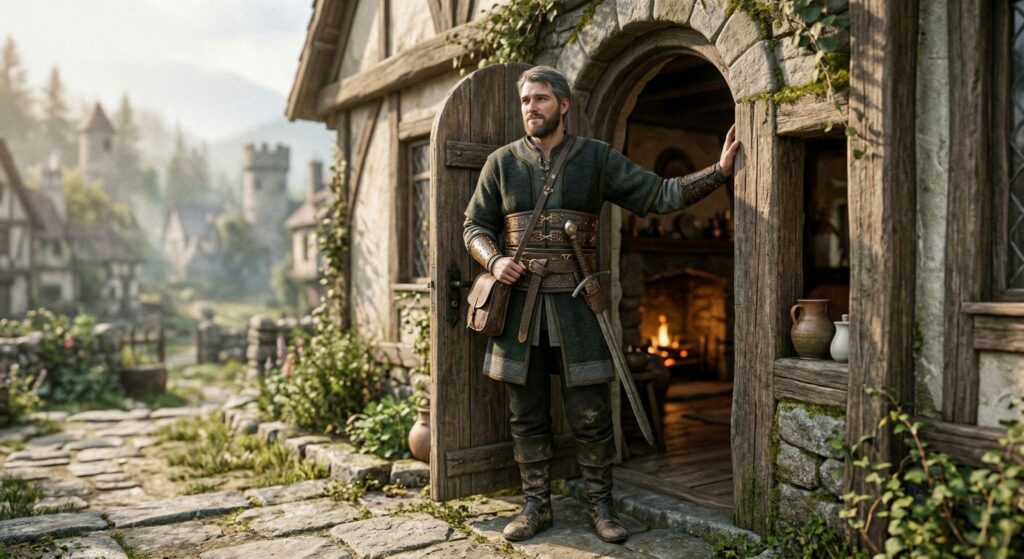
I gave VEO this prompt multiple times, and the image was always similar, with the only variation being how long his hair was.
However, when I gave the AI a prompt like this:
A man in his 40’s stands in the doorway of a dilapidated home. He is tall, almost as tall as the doorway. His hair goes down to his chin, and he ties it behind his head with a leather cord. His eyes are grey, and have a hidden power behind them, but a deep sadness.
He wears a sword on his hip that has a golden hilt with subtle engravings. The hilt is engraved with an eagle.
The man is rugged, and his hands are calloused after years of swordplay. He wears a grey cloak that has been trimmed with red thread. Subtle, but clear, he is an experienced swordsman.
He is neither happy nor sad; he is stoic.
Angle: 3-quarter shot, his body angled so he is not facing us, but we can still see the front of his body and face
Scene: in the doorway of a dilapidated room, the outside light comes from the moon. He stands ominously in the doorway, and a deep and unsettling fog surrounds him.
Camera: Full body shot, ominous. We are inside looking outside.It generated this image.
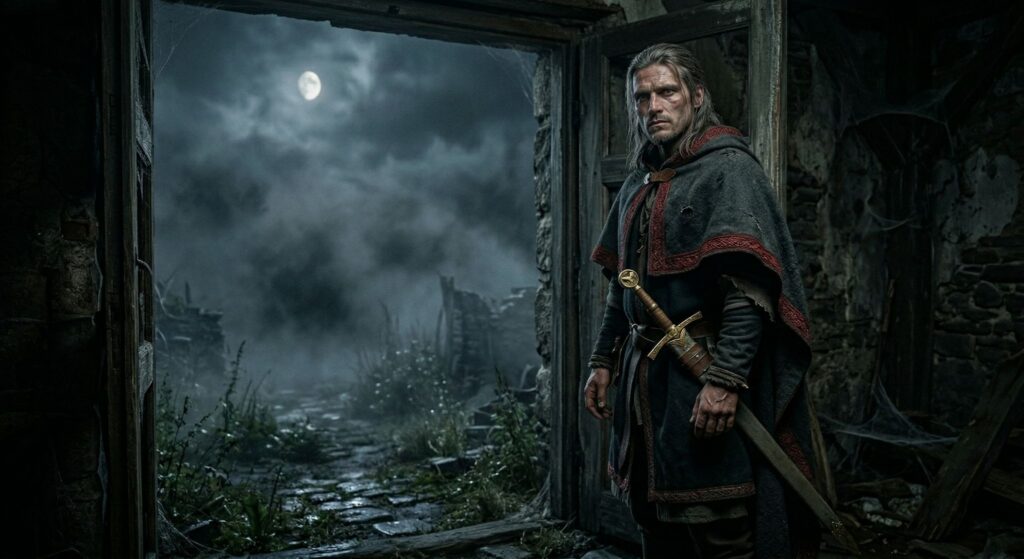
This image had a lot more substance to it; however, I had to spend the time to really understand what I wanted to see myself and write it down so VEO could work from that.
When I gave VEO this prompt multiple times, it produced similar results; however, each one had vastly different characteristics. One iteration looked like Boromir from The Lord of the Rings, another, Geralt from The Witcher.
This small experiment demonstrated the level of detail required when crafting prompts to generate meaningful results. Creating the ‘Stoic man‘ image took 10 minutes of writing, refining, and regenerating prompts (and this is not including the 5-10 minutes it took to actually generate the image itself).
To fully test VEO, I created a 30-second product advertisement. Until this point, I had not explored VEO’s video capabilities, so this was an effective way to assess its performance in a familiar context.
The goal: create an ad for a pair of sunglasses using 100% AI-generated assets.
The outcome:
After spending a few weeks writing, refining, and re-writing prompts, I was finally able to produce a short ad for a pair of sunglasses, which you can watch here.
My thoughts on the final video:
If this video had been produced using traditional methods, there would have been significantly more flexibility with actors, direction, scripting, and lighting. The final product would have been markedly different.
If I were a client who had paid for video production and had received this, I would have been quite disappointed.
My gripes with this video:
- The sunglasses changed shape every time they were on screen
- I asked the AI multiple times for the actors not to have any dialogue (luckily, it was just the first girl that did, but I regenerated the video 5 times, and the girl was still talking).
- All the actors’ movements were stiff. They didn’t flow naturally or seem like they were in their environment.
- VEO had this weird thing where it kept making the huge smiles suddenly appear when I asked for a ‘soft smile’.
- All the ‘actors’ themselves felt soulless.
The limitations:
AI performance depends entirely on the quality of the prompts provided. A basic prompt yields a basic image, while a detailed prompt produces a more comprehensive result. AI does not think creatively or generate original ideas; it interprets instructions rather than creating independently.
When creating the ad, there was no opportunity for spontaneous decisions or collaboration between the director and actors, as is typical on set. Instead, all decisions were made by a single individual sitting at a keyboard.
With all these factors in mind, Google VEO also imposes a daily limit of five video generations. If a generated video contains issues, such as missing elements or unnatural expressions, which is not uncommon in AI videos, you may need to wait 24 hours before attempting another version. This limitation was a recurring challenge for me, and became the reason it took weeks to produce this AI ad.
The cost of an AI video vs. a traditional video
Many claim that AI is more cost-effective than traditional methods. While this is true initially, upon writing this blog, Google VEO charges $400 per month. With a 5-video-per-day limit, users may spend $4,800 annually without achieving the same creative results or the authenticity that comes from having real people on camera.
In contrast, producing a single video for $4,800 may have a higher upfront cost, but the video can be reused indefinitely. If 10 people view it daily over 12 months, the cost per viewer is $1.32, with an irreplaceable, authentic human(s), and creative collaboration.
All this being said, the highest cost of AI-generated videos is time. Every prompt needs careful editing to ensure the generated video makes sense. Even if you write the perfect prompt, the platform may still struggle, meaning the prompt will have to be rewritten and generated again. Not many businesses can afford to reduce the accuracy, quality, and realism of a human-driven story compared to a fully AI-generated video that lacks substance and comes at the risk of the production company’s reputation.
Conclusion
Filmmaking is inherently collaborative. On any set, from major films to small commercials, decisions are shared rather than made by one person. Directors and producers communicate with each other and the entire cast and crew. During these discussions, suggestions often lead to real-time script changes while filming or significant changes to the overarching story once realising it is unfeasible.
While AI has been used to assist in the making of some films here and there, there is currently nothing to suggest that the filmmaking industry is going to crumble anytime soon. Audiences are smart; they can tell when someone is pulling the wool over their eyes, and don’t want to spend upwards of $50 to go to the cinema to see an inauthentic film generated by AI.
My personal opinion is that AI does have a time and a place – such as assisting with copywriting or grammar – but none of it belongs in films or anywhere else in the creative industry.